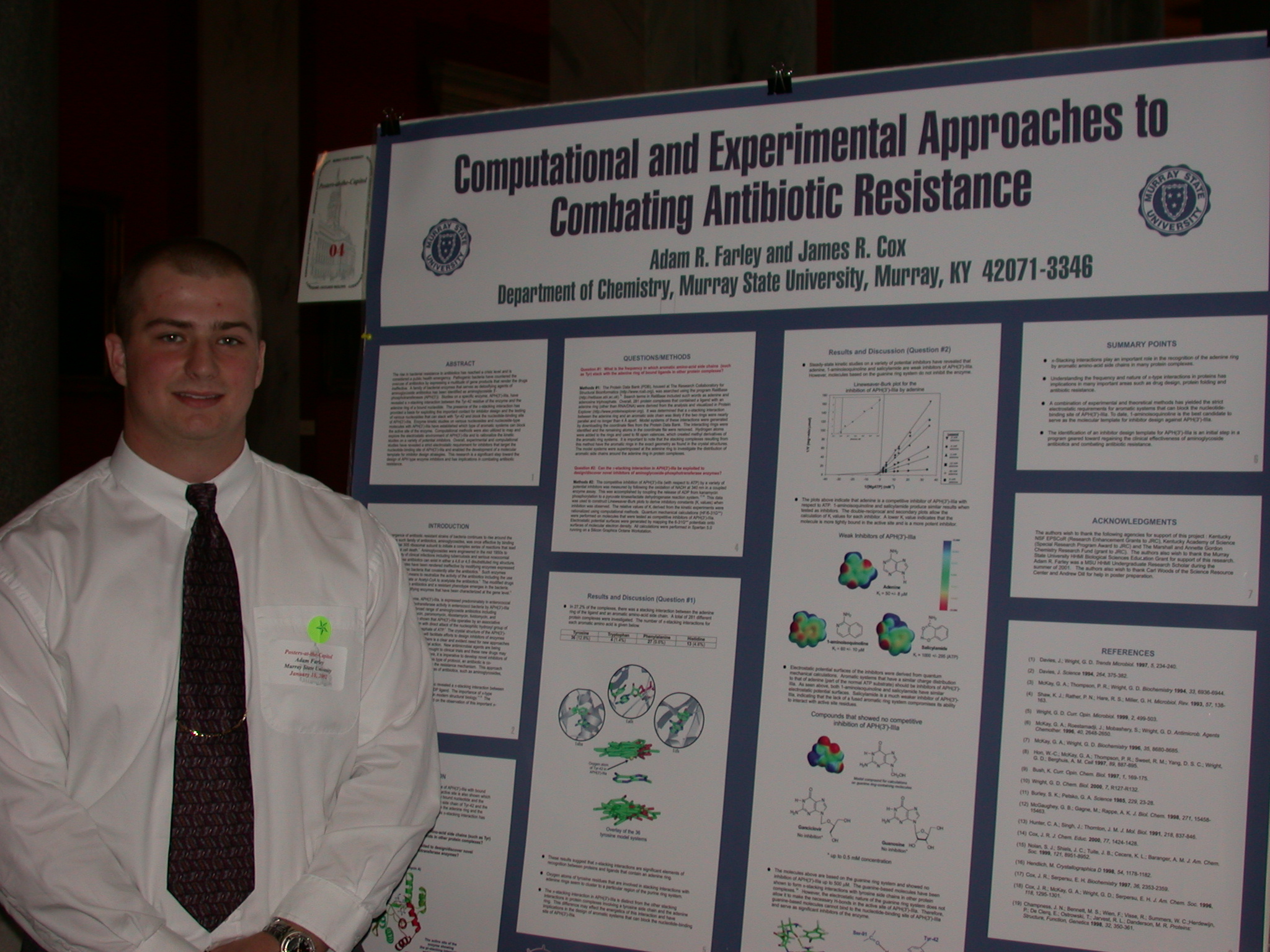
The rise in bacterial resistance to antibiotics
has reached a crisis level and is considered a public health emergency.
Pathogenic bacteria have countered the overuse of antibiotics by expressing
a multitude of gene products that render the drugs ineffective. A family
of bacterial enzymes that serves as detoxifying agents of aminoglycoside
antibiotics has been identified as aminoglycoside 3'- phoshphotransferases
(APH(3')). Studies on a specific enzyme, APH(3')-llla, have revealed a
pi-stacking interaction between the Tyr-42 residue of the enzyme and the
adenine ring of a bound nucleotide. The presence of the pi-stacking interaction
has provided a basis for exploiting this important contact for inhibitor
design and the testing of various nucleosides that can stack with Tyr-42
and block the nucleotide-binding site of APH(3')-llla. Enzyme kinetic studies
on various nucleosides and nucleoside-type molecules with APH(3')-llla
have established which type of aromatic systems can block the active site
of the enzyme. Computational methods were also utilized to map and explore
the electrostatic environment of APH(3')-llla and to rationalize the kinetic
studies on a variety of potential inhibitors. Overall, experimental and
computational studies have revealed a strict electrostatic requirement
for inhibitors that target the nucleotide-binding site of APH(3')-llla
and enabled the development of a molecular template for inhibitor design
strategies. This research is a significant step toward the design of APH
type enzyme inhibitors and has implications in combating antibiotic resistance.
Return
to Abstract List
Return
to URSA HomePage