
Effects
of habitat size on stress, immunocompetence, and parasitic infections in
free living populations of white-footed mice. National
Science Foundation EPSCoR.
Infectious diseases that affect wild and domestic animal and human populations
are increasing in prevalence worldwide. Most of these diseases have
been associated with alteration of natural habitats by humans (e.g., agriculture,
urbanization) that, presumably, causes increased stress in wild animal
populations. As wild animal populations become more stressed, they
are also more likely to carry parasites and diseases. As a result,
humans living in areas near to disturbed habitats may have an increased
risk of exposure to disease. Dr. Claire Fuller and I will investigate
the relationships among habitat disturbance, stress, immunocompetence,
and disease in wild populations of Peromyscus leucopus (white-footed
mouse). We will determine and compare the levels of stress (as indicated
by glucocorticoids) and dietary protein, levels of innate, humoral, and
cell-mediated immune function, and prevalence of parasitic infections in
wild white-footed mouse in small and large patches of habitat in winter
and summer. Our long-term objective is to produce and assess GIS-based
models that predict the threat that habitat alteration poses to the health
of wild mammal populations and the risk of disease incurred by nearby human
populations.
Consequences
of Male Chemosignals and Condition on Female Mate Choice and Reproductive
Success. National Science Foundation
EPSCoR and the Committee on Institutional Studies and Research, MSU.
For
the past three years I have been investigating the effects of male chemosignals
on female odor preferences and female mate choice in the prairie vole (Microtus
ochrogaster). I and several undergraduate students found a positive relationship
between male testosterone level and the attractiveness of male odors to
females. The relationship between testosterone level and odor attractiveness
was affected negatively, however, by depriving males of food post-weaning;
suggesting an influence of non-gonadal hormones. One very interesting result
was that, in contrast to food-deprivation post-weaning, food-deprivation
during gestation enhanced the attractiveness of male odors to females and
enhanced testosterone level. Jill Kruper, a Ph.D. student, is currently
determining whether male house mice (Mus musculus) with more attractive
odors are preferred by females as social partners and as mates and, through
paternity analyses, whether males with more attractive odors have higher
reproductive success. The dependent variables that she is investigating
are the testosterone level, corticosteroid level, and the nutritional history
of males.
 |
 |
|
| A female house mice (central chamber) is free to move about the enclosure, mating with which ever male (i.e., high testosterone or low testosterone) she chooses. | Male mice (left and right chambers) are tethered and are restricted to the area surrounding their respective chambers. |
Vertebrate
Distribution Mapping Component of theKentucky
Gap Analysis Project. Kentucky Department
of Fish and Wildlife Resources and the United States Geological
Survey.
The
goals of the project are 1) to provide maps of known confidence that predict
the distributions of terrestrial vertebrates in Kentucky in order to support
analysis of the conservation status of vertebrate species and 2) develop
a database of locational records, geographic range, wildlife habitat associations,
and predicted distributions of each vertebrate species for the long-term
utility of the Kentucky Department of Fish and wildlife Resources and its
cooperators. Howard Whiteman and I are working closely
with the Land Cover team headed by Tom Kind at the Mid-America Remote Sensing
Center at MSU as we conduct the vertebrate mapping portion of the GAP project
for Kentucky.
 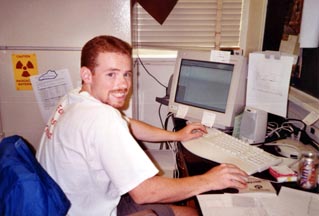
Terry Derting and Matt Cole in Frankfort Adam Smith working on GAP
|

"Using Ranges of Terrestrial Vertebrates to Analyze Patterns of Species Diversity in Kentucky" - A KY-GAP Product
Assessment
of the Terrestrial Small Mammal Fauna of Terrapin Creek State Nature Preserve.
Kentucky
State Nature Preserve Commission. Undergraduate students and
I are conducting a survey of the terrestrial small mammals that occur at
Terrapin Creek State Nature Preserve (TCSNP). The preserve was created
in 1992 and encompasses 160 acres of a wetland complex in the East Gulf
Coastal Plain. We are conducting trapping sessions, using live traps
and pitfall traps, every 6 weeks for a one year period. Our objective
is to characterize the mammalian fauna inhabiting the preserve. These
and other data will be used by KSNPC to manage the preserve.
 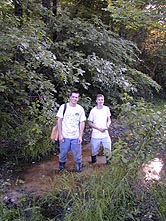
Alan Whited and Kelly Veach setting pitfall traps Even pre med students helped
|

Reconstructing
the Introductory Biology Curriculum Using Inquiry Based Approaches.
National Science Foundation.
Four
colleagues and I are working to enhance learning by our biology majors
through reconstruction of our introductory
biology curriculum. The project has five major objectives: (1) combining
broad exposure of students to basic scientific concepts with significant
opportunities for in-depth understanding through direct investigation,
(2) placing a greater emphasis on concepts, processes, and active scientific
inquiry, (3) developing the tools needed by students to grasp and
explore new scientific topics at the outset of their undergraduate curriculum,
(4) providing a supportive student-centered curriculum that facilitates
that transition of students from a high school to an undergraduate level
of study, and (5) enhancing the ability of faculty to adapt and introduce
newly developed materials, pedagogical methods, and technologies into their
courses. The curriculum will be based on adaptation and implementation
of exemplary teaching practices and laboratory investigations that are
inquiry-based. As a result of our new curriculum, we expect students
will develop the intellectual tools and knowledge of content necessary
for enhanced learning in advanced courses, while increasing their confidence
and interest in biological study.
 |
 |
|
|
(From left to right) Jeremy Woodward, Lee Webb, Matt Richardson, and Jill Krahwinkel presenting their research. |
Faculty
Institutes for Reforming Science Teaching II. National
Science Foundation.
FIRST II is a nationwide project in which teams of faculty at five field
stations or sites recruit and then train science faculty in their geographic
region. A faculty team
at Murray State University will be working with teams of science faculty
from regional colleges and universities to develop their skills as teachers
of active inquiry and their knowledge of current pedagogy. The leadership
team at MSU consists of Terry Derting (Department of Biological Sciences),
Renee Fister (Department of Mathematics), and John Mateja (Department of
Physics and Engineering Physics). They will be working with a new
field station team from the University of Akron and with faculty teams
from MSU, Penn Valley Community College (MO), and other regional faculty
teams. The specific goals of the FIRST II project are:
1) Enable faculty
to gain experience in active, inquiry-based science teaching that increases
student learning through workshops that model this kind of teaching;
2) Enable faculty
to learn and use multiple assessment strategies that provide evidence of
student learning which their peers accept;
3) Facilitate collaboration
among faculty about their reforms toward achieving excellence in science
teaching , and about the emerging criteria and strategies for the scholarship
of teaching, so that teaching can be recognized, evaluated, and rewarded
within institutions;
4) Use field stations
and sites in eight regions throughout the United States as foci to maintain
and expand coalitions of faculty who will implement and sustain reform
in undergraduate biology education in their colleges and univerisities;
5) Develop teams
as regional professional developers of biology faculty;
6) Support a national
dissemination network to sustain improvement in teaching initiated by faculty.
Click to return to main page.